Becoming a Guitar Player – The Self Not Taken
The Guitar in the Corner
Oliver Wendell Holmes wrote that most people go to their graves with their music still inside them. He wasn’t talking about professional musicians. He was talking about everyone else.
There’s a club that nobody talks about openly. It doesn’t have meetings, dues, or a membership card. You don’t apply, and you don’t audition. You join the moment the guitar first means something to you, and hundreds of millions of people around the world are in this club.
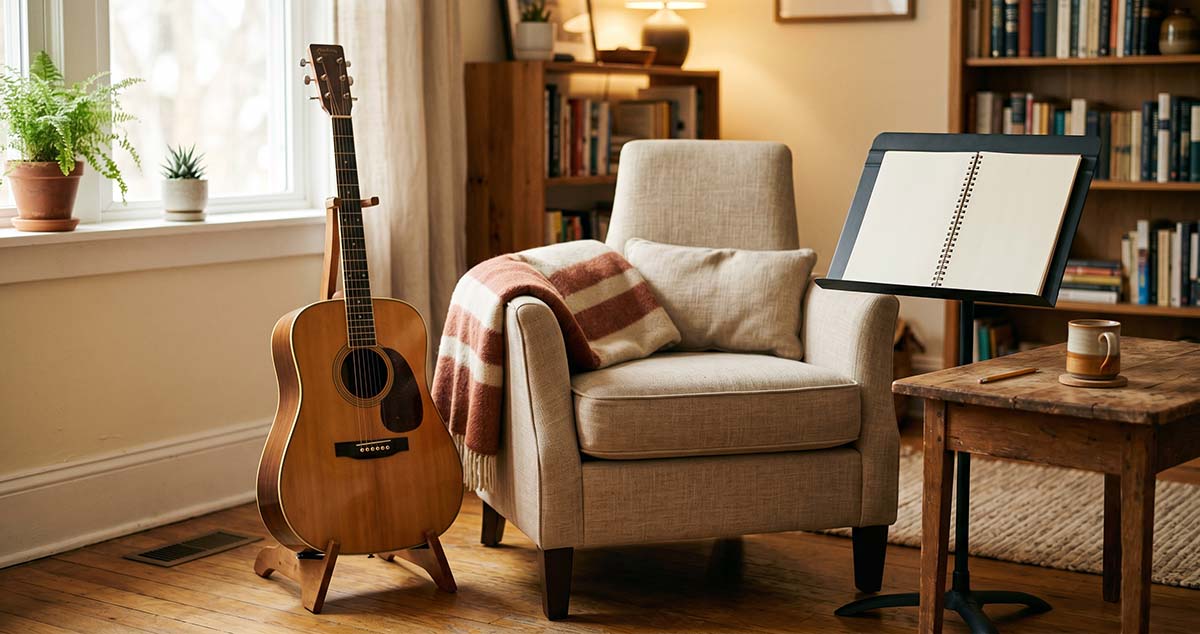
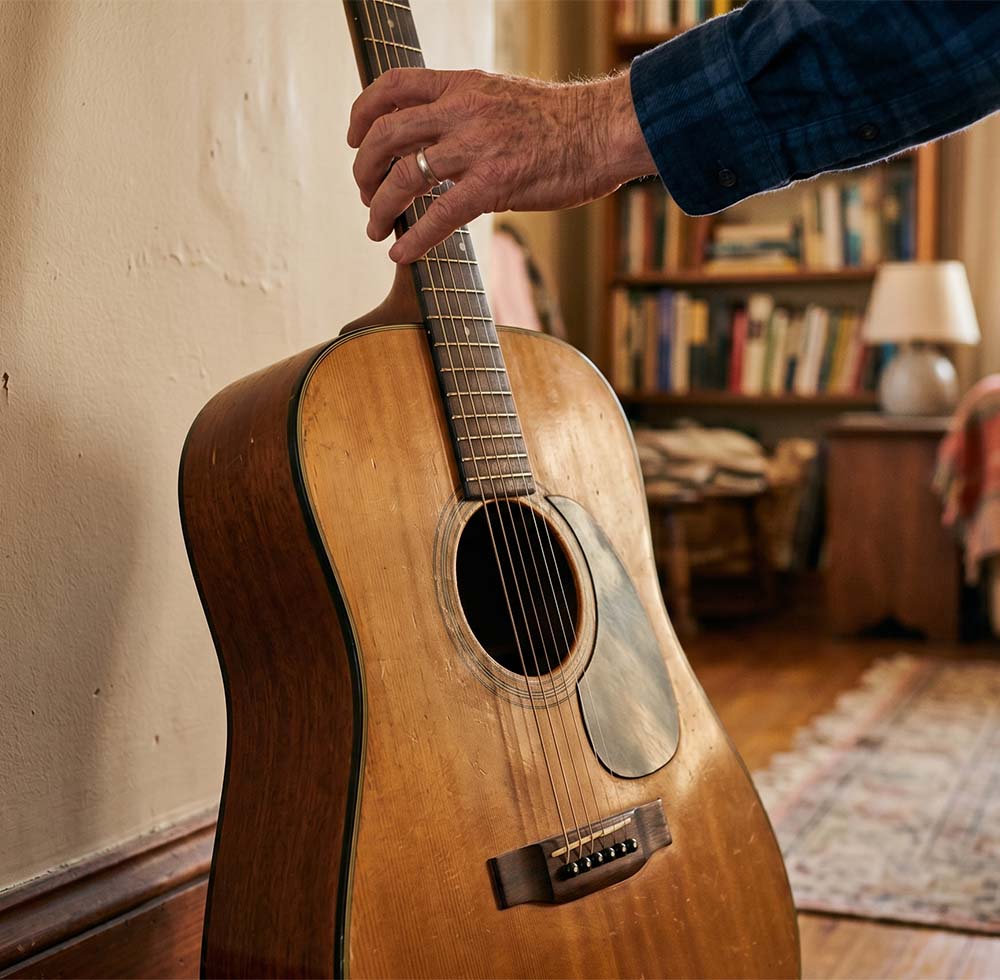
You probably have a guitar now. The one that moved with you through three apartments, two jobs, and relationships you thought would last forever but didn’t. The one leaning against the wall in the corner of a room you walk past every single day, yet rarely finds its way into your arms. That guitar is a sign that something in you is still unfinished.
What the Guitar Represents
The guitar has never been just another musical instrument. For seventy years, it’s been the sound of rebellion, longing, heartbreak, freedom, youth, and reinvention: rock and roll, the British Invasion, blues, folk, punk, grunge, singer-songwriters in small rooms connecting to souls with three chords and something honest to say.
When you felt drawn to the guitar specifically, rather than the piano, the violin, or some other instrument, that probably wasn’t random. What many adult guitar players eventually discover is that they’re not actually chasing virtuosity. What they want is freedom. The freedom to play what they want, when they want, in the way that feels meaningful to them. More than almost any other instrument, the guitar has always belonged to people trying to say something personal. Expression.
The Self Not Taken
In 1986, psychologists Hazel Markus and Paula Nurius introduced a concept that quietly explains a great deal about adult life. They called them possible selves: the versions of ourselves we hoped we might become, the versions we expected to become, and the versions we slowly began to fear we never would. Possible selves shape how we see ourselves, what we attempt, what we avoid, and what we quietly mourn.
Most adults carry a possible self that involves music. And for many of them, the image is specific: themselves, playing guitar. Then adult life happened: careers, children, bills, exhaustion, responsibility. And when that possible self gets pushed aside long enough, psychology has a name for it: the self not taken. The creative identity that was deferred, but never fully abandoned.
Because it doesn’t disappear. It shows up in the pull you still feel when you hear a certain song, in the way you slow down when passing a music store, in the neglected guitar that has quietly moved with you through every chapter of your adult life.
Developmental psychologist Erik Erikson believed that later adulthood is shaped by a quiet but important choice: whether we continue growing, creating, and becoming something new, or slowly settle into repetition. That’s why finally learning guitar matters more than people think. Learning guitar is an act of growth, an act of expansion, a refusal to become psychologically smaller simply because the years have passed. Psychology has a word for what you’re doing when you pick up that instrument: becoming.
Why the Guitar Stays in the Corner
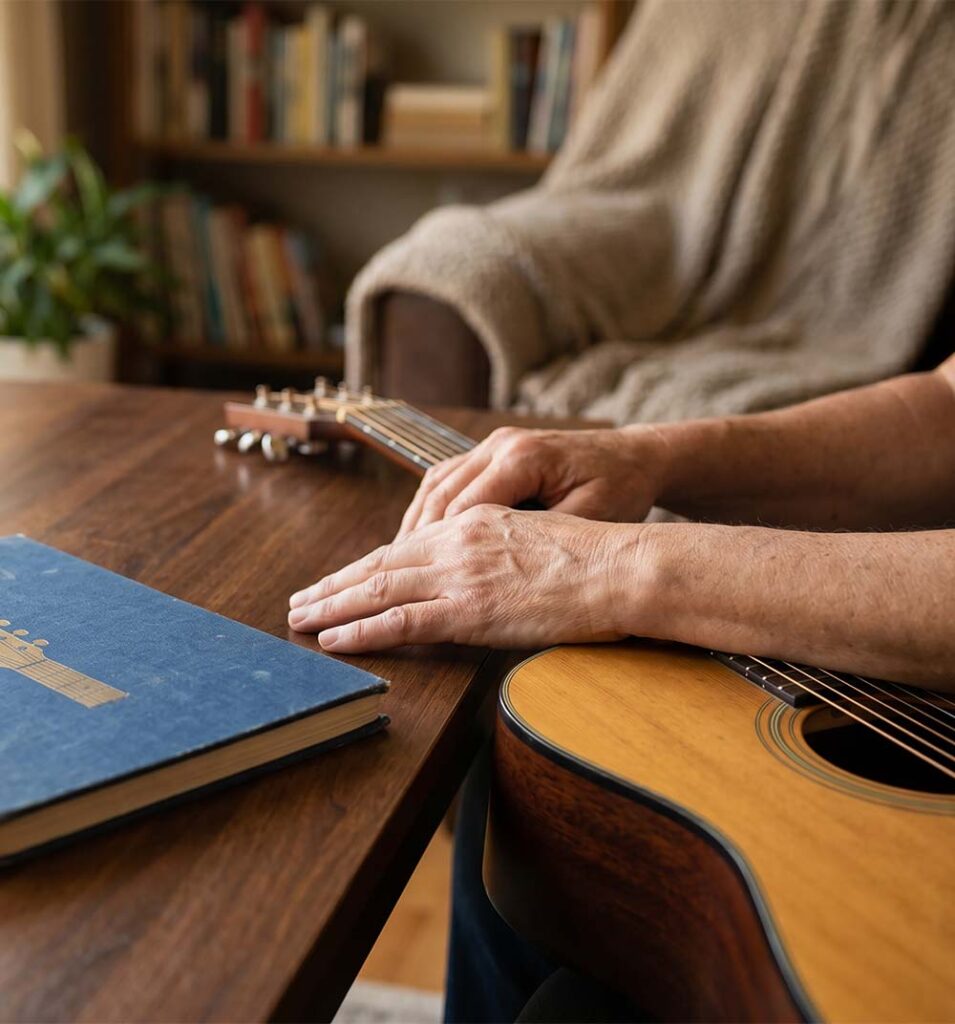
So why do so many people remain suspended between wanting to play and actually becoming a guitar player? The research is surprisingly clear on this. The gap between guitar owner and guitar player isn’t primarily about talent or time, and it isn’t even primarily about motivation, because the motivation is obviously there. The guitar is still in the house. Or at least in your thoughts. That means something.
The gap persists because the conditions were wrong. Most adults who tried to learn guitar and stopped weren’t stopped by biology or age. They were stopped by a learning system originally designed for children, applied to adults with almost no modification, by teachers who didn’t understand adult cognition and practice methods that ignored adult psychology. For many adults, the result was frustration, embarrassment, and eventually withdrawal. That’s a structural problem.
Difficulty as Importance
Here’s what the research on identity-based motivation shows about the moment things get challenging, and they will get challenging. When adults encounter difficulty while learning a new skill, they tend to interpret it through one of two frameworks.
The first is difficulty as impossibility: this is hard because I can’t do it, because I’m too old. Once that interpretation takes hold, people stop. The second is difficulty as importance: this is hard because it matters, because I’m building something real.
Adults who successfully learn guitar are the ones who learn that frustration signals something is happening. The friction is part of the process. The discomfort is evidence of growth.
The Dip
Knowing how to interpret difficulty is only half the preparation. The other half is knowing what’s coming. The path between guitar hopeful and guitar player passes through a place musicians and researchers understand well. Seth Godin called it The Dip, the period after the initial excitement fades, when the mechanics begin to feel overwhelming and progress becomes difficult to see.
Most people who quit do it in The Dip. They quit because nobody told them The Dip was coming, what it meant, or how to get through it. This series exists for that moment, to make sure that when you reach it, you know exactly what’s happening and why it’s worth pushing through.
The Invitation
If you’ve made it this far, you’re likely a member of the club. The possible self doesn’t expire. It waits for the conditions to become right.
If they’ve become right for you, book a free consultation and we’ll talk about what becoming a guitar player actually looks like for you.
Is it too late to learn guitar as an adult?
It is not too late to learn guitar as an adult. The first stage may feel awkward because your hands, ears, and attention are learning a new relationship with the instrument. That does not mean the door has closed. It means the conditions around your learning need to fit your life.
Why does learning guitar feel so personal now?
Guitar can carry more meaning than a normal hobby because it may be tied to a version of yourself you still care about. When you pick it up again, you are not only learning chords. You are asking whether that creative part of you is still available.
What are possible selves?
Possible selves are the versions of yourself you hope to become, expect to become, or fear you may never become. In this piece, the possible self is the version of you that plays guitar. That image can stay with you for years because it is connected to identity, not just entertainment.
What does “the self not taken” mean?
The self not taken is the creative identity that was pushed aside but not fully abandoned. You may have stopped practicing, delayed lessons, or let life take over. But the desire can still remain. The guitar in the corner may be evidence that this part of you never completely disappeared.
What is The Dip in learning guitar?
The Dip is the stage after the early excitement fades and the work becomes more visible. Chord changes feel slow, rhythm feels uneven, and progress can be hard to notice. It is a normal part of learning. Knowing it is coming makes it easier to keep going through it.
Does frustration mean I am not meant to play guitar?
Frustration does not automatically mean you are not meant to play. The brain and body need repetition before new movements feel natural. The hand may feel clumsy before it feels coordinated. That discomfort can be part of learning, not proof that you waited too long.
What should I actually do if I want to start again?
Start by making the path smaller and more realistic. Use shorter practice sessions, simpler songs, slower chord changes, and a learning plan that respects adult life. You do not need to prove anything quickly. You need conditions that help you return to the guitar without turning every mistake into a verdict.
Why did I quit guitar before?
Quitting before does not have to mean you lacked motivation. You may have been trying to learn through a system that did not fit how you think, practice, or handle frustration as an adult. When the approach changes, the experience can change too.
